
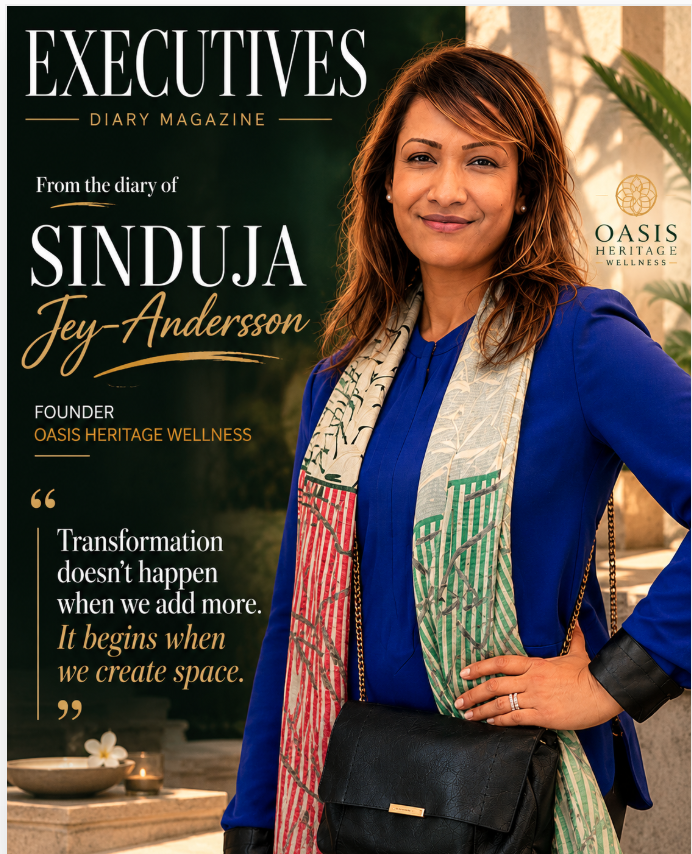
Sinduja Jey-Andersson
Modern Wellness Has the Same Problem as Corporate Supply ChainsMost executives know what happens when a business treats symptoms instead of causes.
A missed target triggers another meeting. A delayed delivery triggers another process. A declining metric triggers another intervention. Yet the underlying issue remains untouched because nobody steps back far enough to see the system.
Sinduja Jey-Andersson believes the same thing is happening in human health. And after spending much of her career solving complex operational problems inside some of the world’s largest organisations, she decided the body deserved the same systems thinking businesses demand from their leaders.
Sinduja Jey-Andersson is the Founder of Oasis Heritage Wellness, a precision-led health immersion company designed to support executive resilience, cognitive performance, recovery, and long-term healthspan through a systems-based approach to restoration.
The Executive Who Kept Seeing the Same Pattern
Long before Oasis Heritage Wellness existed, Sinduja Jey-Andersson built her career in environments where complexity was normal.
She worked across finance, commercial operations, supply chain management, product launches, logistics transformation, and strategic planning. Her career included roles at Sotheby’s, GSK, Immunocore, Unilever, Collins Aerospace, and other global organisations where outcomes depended on understanding how interconnected systems behaved under pressure.

The work was demanding. The stakes were often significant. The lesson was consistent.
Problems rarely existed in isolation.
What appeared to be a manufacturing issue could be a planning issue. What looked like a forecasting issue could be a communication issue. What seemed like a logistics challenge could originate much earlier in the system.
That observation stayed with her.
At the same time, she was developing a deep interest in preventative health, Ayurvedic science, nervous system regulation, metabolic wellbeing, and human resilience. Over more than a decade, she studied how different health systems approached recovery, adaptation, and long-term vitality.
Eventually, the overlap became impossible to ignore.
The same fragmentation she had spent years correcting inside organisations appeared everywhere in modern health.
People were treating symptoms. Systems were being overlooked.
When Success Stops Looking Like Health
One of the ideas Sinduja returns to repeatedly is that many high performers appear healthy right until they don’t.
They are productive. They are successful. They are functioning.
Yet beneath the surface, energy becomes less consistent. Recovery takes longer. Sleep quality shifts. Mental clarity fluctuates. Digestion becomes unpredictable. Stress becomes harder to shake.
The common response is to add another intervention.
Another supplement.
Another protocol.
Another productivity strategy.
Sinduja sees a different problem.
That perspective has become one of the foundational principles behind Oasis Heritage Wellness.
Rather than asking what should be added next, she asks what is preventing the body from doing what it was designed to do already.
The distinction matters because it changes the objective entirely.
The goal stops being optimisation.
The goal becomes restoration.
For executives accustomed to solving problems through effort, that idea can feel counterintuitive. Yet Sinduja believes many of the people she serves are not suffering from a lack of discipline. They are experiencing the cumulative effect of systems operating under continuous load.
That belief sits at the centre of the Oasis model.
Building Oasis Heritage Wellness Around a Different Question
Most wellness businesses begin with treatments.
Oasis Heritage Wellness began with a question.
What happens when health is approached as an interconnected system rather than a collection of separate concerns?
That question shaped every aspect of the company’s development.
The Oasis model combines Ayurvedic metabolic science, nervous system regulation, functional nutrition, gut and liver support, and personalised immersion experiences designed to help individuals restore physiological balance over time.

Yet the company deliberately avoids presenting these elements as isolated solutions.
That would undermine the entire philosophy.
Instead, the focus is on understanding how different systems influence one another.
Digestion affects energy.
Recovery affects resilience.
Sleep affects cognitive performance.
Nervous system regulation influences almost everything.
As Sinduja explains, “Symptoms are often signals, not the source.”
The result is a business positioned less as a traditional wellness retreat and more as a structured environment for systemic restoration.
That distinction is important.
The people Oasis serves are not necessarily looking for temporary relief. Many are seeking a more durable foundation for performance, longevity, and wellbeing.
In Sinduja’s view, sustainable high performance is not created through constant acceleration.
It is created through the ability to recover.
The Founder Story Hidden Behind the Business Story
What makes Sinduja Jey-Andersson’s story compelling is not simply that she changed industries.
Many people change industries.
Few bring such a distinct perspective with them.
The same woman who once built forecasting frameworks across European markets, improved operational performance inside multinational businesses, and managed complex commercial systems now speaks about health through remarkably similar principles.
Patterns.
Interdependencies.
Root causes.
Long-term outcomes.
The language changed.
The thinking did not.
That consistency helps explain why Oasis Heritage Wellness feels different from many wellness brands.
It was not created by someone chasing trends.
It was created by someone who spent years studying how systems succeed, how systems fail, and what happens when leaders focus only on visible symptoms.
The transition also reflects something she frequently discusses when speaking about entrepreneurship.
Growth is rarely linear.
Setbacks often teach more than successes.
Clarity frequently emerges from periods of uncertainty.
Those beliefs appear throughout her reflections on leadership, resilience, and rebuilding.
For Sinduja, founding Oasis was not about abandoning her previous career.
It was about applying decades of experience to a different system.
The human one.
Today, Sinduja Jey-Andersson continues to build strategic partnerships across luxury hospitality, longevity, private client services, and high-performance wellbeing while expanding the reach of Oasis Heritage Wellness. Her mission remains centred on helping individuals cultivate resilience, restoration, and long-term healthspan through a more integrated approach to health.
Because the future of performance may not belong to those who can push the hardest, but to those who know how to recover well enough to keep going.