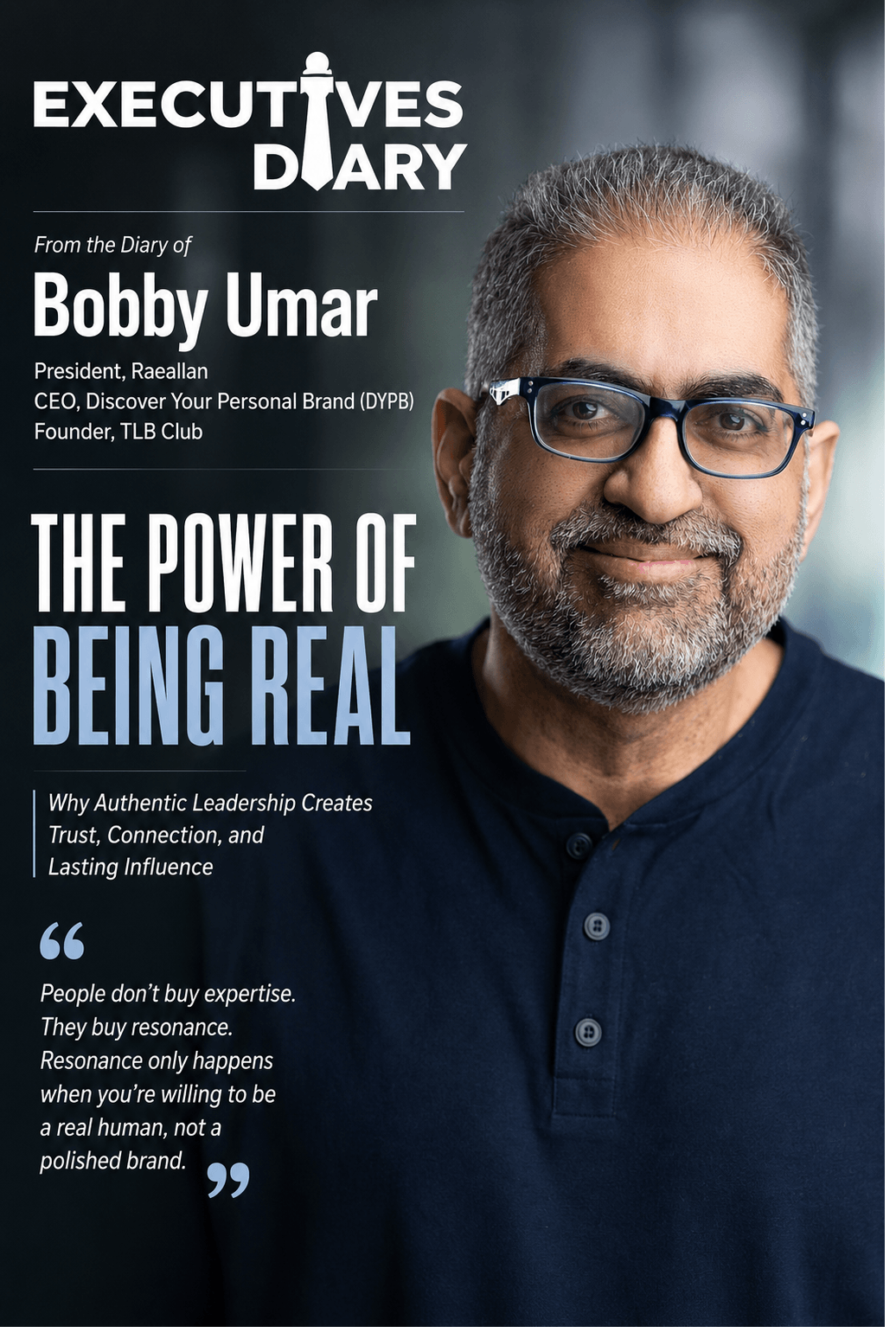
Bobby Umar
Has Spent 25 Years Teaching Leaders to Be Real. The Hardest Person to Convince Was Himself.There is a particular kind of silence that happens in a conference ballroom when a speaker walks on stage carrying the weight of their own contradictions. The lights are hot, the coffee is cold, and a few hundred executives are waiting to see which version shows up: the polished expert or the flawed human.
For years, Bobby Umar delivered the version he thought the room wanted. Then his life started coming apart in ways that do not fit on a speaker bio. Diabetes. Binge eating disorder. A liver specialist told him his organ was “grossly enlarged and fatty.” An eye doctor warned about “the beginning of mild diabetes in the eyes.”
So he did something that still makes most leaders flinch. He went online and told the truth.
“I’m frustrated. I feel guilty and ashamed. I often wonder WTF is wrong with me,” he wrote publicly to hundreds of thousands of followers. “The truth is, it all comes down to ME. I have to do the work. I have to own this.”
That tension between polished expert and struggling human is where Bobby Umar actually lives. It is also why executives keep calling.
The Connector Who Makes Strangers Confess
Bobby Umar is President of Raeallan, a Toronto-based training and speaking company, the CEO of DYPB – Discover Your Personal Brand, and founder of the Thought Leadership Branding Club (aka TLB Club). A five-time TEDx Speaker, a 2x LinkedIn Top Voice and Inc. Magazine Top 100 Leadership Speaker alongside Richard Branson and Brené Brown, he has delivered over 1,000 keynotes across four continents. His LinkedIn bio says people always want to hug him and share deep personal thoughts after first meetings. That is not a marketing copy. That is documented pattern recognition.
He built his reputation on one core belief: people do not remember polished, they remember real.
From Engineering Blueprints to Human Architecture
The path here was not obvious. Umar graduated from McGill University with a mechanical engineering degree, a minor in music and French, and scholarships he eventually lost when undiagnosed ADHD quietly derailed his academic performance. Nobody had language for neurodivergence then, including him.
He moved into brand marketing at Kraft and Unilever, where he discovered something more valuable than any engineering principle: he was extraordinarily good with people. Not in a surface-level way, but in a manner that made people feel genuinely seen. He ran leadership offsites where he showed up as a real human, funny and curious, and year after year, they asked him back.
Simultaneously, he spent a few years at Second City, earning certification through their Advanced Conservatory program. That training taught him to stay present, listen before responding, and find truth in any scene without flinching. It also surrounded him with neurodivergent performers who had learned to turn their different wiring into professional assets.
When he launched Raeallan in 2006, the relationships he had built through genuine connection became his foundation. People referred to him not because he had a polished pitch, but because he had been real with them. The business became proof of concept for everything he would teach.
The Work That Demands You Bleed
Today, Umar operates three interconnected businesses, each expressing the same conviction: authenticity and human connection are not soft skills but the most commercially durable capabilities a leader can develop.
His TEDx coaching program, now a primary revenue engine with a target of 60 clients annually, helps C-suite leaders excavate their real stories to build greater authority and trust. “People don’t buy expertise. They buy resonance,” he tells clients. “Resonance only happens when you’re willing to be a real human, not a polished brand.” Clients report measurable shifts: higher team trust, stronger external positioning, more inbound opportunities, and better mental health because the performance burden disappears.
At Raeallan, he has delivered keynotes, workshops and virtual training to organizations including TELUS, TD Canada Trust, CIBC, Microsoft and Bombardier across topics like vulnerable storytelling, personal branding, and digital thought leadership. His goal is rebuilding to 20-30 major stages annually, the frequency where he says he feels most alive.
The TLB Club addresses a specific crisis he sees repeatedly: brilliant entrepreneurial experts and small business owners who create content but cannot convert visibility into revenue. They hit annual ceilings around $40,000 for side hustlers or $120,000 for consultants and stay stuck. “They’re using a hope-based strategy: ‘I’ll create great content and clients will magically appear,’” he explains. TLB Club provides community, monetization strategy, and confidence to charge appropriately through weekly coaching calls, monthly masterclasses, and direct access to Umar himself.
His digital presence anchors everything: 750,000+ followers, 2 billion+ impressions, twice-named LinkedIn Top Voice. He uses platforms not for broadcasting but genuine community building, posting polls that have generated 30,000+ votes and sharing raw health updates that draw hundreds of supportive comments.
The Revival He Did Not Know He Needed
In 2025, Umar received an ADHD diagnosis at 54, finally naming what had shaped his entire life. That same year, he returned to musical theatre after 18 years, playing his dream role of Collins in a community production of Rent. He calls 2026 his year of Revival.
“I’ve learned to use my ADHD as a design principle, not an apology,” he says. “Performing reminds me that presence isn’t a technique. It’s a way of being in the room with your whole self.”
The musical became medicine during a season of rebuilding his keynote business, managing chronic illness, and navigating his teenagers’ growing independence while making weekly breakfast visits with his aging parents , and his mom loves when he posts about her.
His revenue goal is clear: $5 million within three years. But it sits alongside non-negotiables: time with family, creative outlets, and the flexibility to be present for what matters. “The business is the vehicle. Freedom is the destination.”
Whenever he shared personal posts about his health challenges publicly, he was not seeking engagement but practicing what he preaches. After 25 years of telling executives that truth connects us, he refuses to exempt himself from that standard.
The hardest person to convince about the power of being real remains the one who walks on stage. And that is precisely why, when he asks a room full of leaders to drop their performance and say the truth, they believe him.
He is not selling the destination. He is walking the same road.